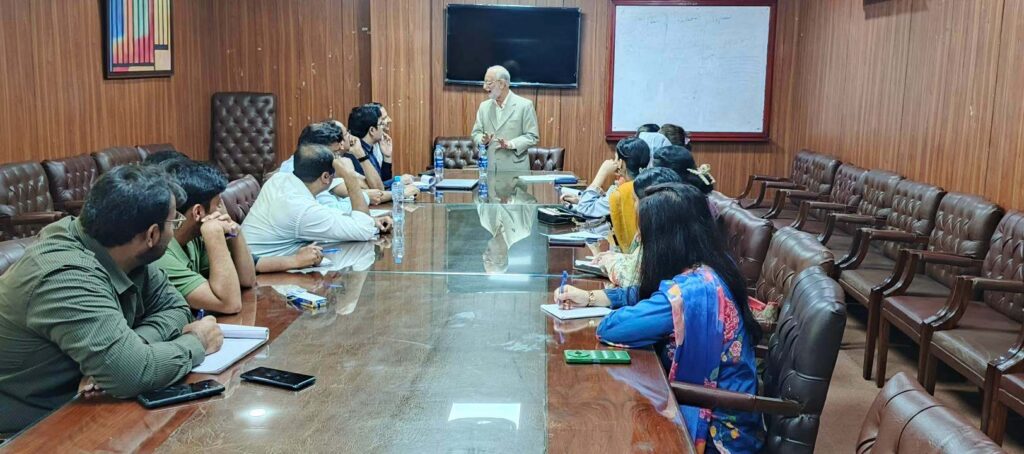
Advanced Training Session at Institute of Social and Cultural Studies – University of the Punjab Lahore
Advanced Training Session at ISCS for Faculty & Postgraduate Scholars — Day One: From Classical Thought to Social Data: Rethinking How We Understand Society The Institute of Social and Cultural Studies (ISCS) is currently hosting a two-day capacity-building workshop on Advanced Social Research, Sociological Theory and Social Thought, being held on August 19–20, 2026. The workshop has been specifically designed for ISCS faculty members and PhD scholars/graduates in Sociology, with a focus on advanced discussions of classical non-Western social thought and the methodological complexities of opinion surveys. We are honored to have Dr. Ijaz Shafi Gilani, Founder and Chairman of Gallup Pakistan, a graduate of the Massachusetts Institute of Technology (MIT), a leading authority on public opinion research, and an eminent scholar of social and political thought, leading this advanced training workshop as the resource person. On August 19, 2026, the first day of the workshop commenced with Dr. Gilani introducing participants to the work of Gallup Pakistan in the field of opinion surveys. He engaged the participants in a detailed discussion of the key methodological complexities involved in conducting and interpreting opinion polls, highlighting issues that require particular attention in the production and analysis of survey data. The second half of the session was devoted to a highly engaging and intellectually enriching discussion of five major works in classical social thought, with particular emphasis on non-Western intellectual traditions. The works discussed included: • A History of Western Philosophy — Bertrand Russell (1945) • Ḥujjat Allāh al-Bālighah — Shāh Walī Allāh (18th century) • Al-Muqaddimah — Ibn Khaldūn (1377) • Kīmiyā-yi Saʿādat — Al-Ghazālī (c. 1102–1106) • Kashf al-Maḥjūb — Al-Hujwīrī (c. 1058) The discussion provided participants with an opportunity to revisit foundational questions concerning human society, knowledge, morality, history, spirituality, social order, and the nature of social change, while exploring the intellectual continuities and differences between classical non-Western traditions and contemporary social thought. At the conclusion of the first day of training, Dr. Gilani introduced the participants to Gallup Pakistan’s extensive social datasets, highlighting the breadth and richness of social data generated through its opinion surveys and research. The session concluded with an engaging discussion of the possibilities and challenges involved in working with large-scale social data, setting the stage for the second day of the training, which will continue this exploration of social data and its applications in social research. In addition to the ISCS Director and faculty members, PhD and MPhil scholars currently enrolled at the Institute participated enthusiastically in the session. The workshop offered an important platform for engaging with key academic debates in social research and classical social thought that continue to shape the social sciences, while also examining how ideas developed in medieval intellectual traditions can be meaningfully revisited and brought into dialogue with the contemporary academic world. We are confident that this intellectually rigorous and enriching two-day workshop will make a significant contribution to strengthening the academic and research capacities of our faculty and scholars, while further expanding ISCS’s engagement with major classical and contemporary debates in the social sciences. We look forward to an equally stimulating and intellectually enriching second day of the workshop tomorrow.